

By Eleanora Ferrante | College Admissions & College Finances | Updated for 2025–2026
If you’re the parent of a high schooler, or a student who wants to stay ahead, August 1st, October 1st, April 1st and May 1st should already be on your calendar. Miss them, and you could miss out on financial aid, scholarship money, or even your top-choice school.
The college admissions process isn’t a sprint you cram into senior year. It’s a four-year marathon that starts the moment your student sets foot in high school. And the families who approach it with a plan, year by year, step by step, consistently have better outcomes: more choices, stronger applications, and more money.
This college admissions timeline checklist, co-created with Vicki Vollweiler, founder of College Financial Prep, gives you the full picture: what to do, when to do it, and why it matters. Whether you’re a freshman just getting started or a senior in the final stretch, here’s your college application timeline template and your roadmap.
Jump to a Section:
Freshman Year: Explore, Experiment, Begin
Sophomore Year: Deepen, Focus, Prepare
Junior Year: Execute, Visit, Build Relationships
Senior Year: Execute, Apply, Decide
The Questions Most Families Forget to Ask
College Admissions Timeline: What to Do Every Year From 9th to 12th Grade
Why Starting Early Is the Biggest Advantage in College Admissions
Most families don’t start thinking seriously about college until junior year. By then, some decisions, courses taken, activities pursued, and grades earned are already locked in. The students who arrive at senior year with the strongest applications aren’t necessarily the smartest. They’re the ones who started with intention.
That’s what this timeline is for.
Freshman Year: Explore, Experiment, Begin
Freshman year is not the time to optimize. It’s the time to explore.
- Try the club you’ve never heard of.
- Volunteer somewhere unexpected.
- Take a class that stretches you.
The goal isn’t to build your resume yet. It’s to discover what you actually care about, so that when the time comes to build a compelling application, you have material to work with.
Academics
- Focus on building strong study habits and finishing freshman year with grades you’re proud of. GPA is cumulative, what you earn now counts.
- Plan your sophomore year schedule with intention. Choose the most rigorous courses that are the right fit for you, not just what looks impressive, but what you can genuinely succeed in.
Activities & Exploration
- Join clubs, sports, arts programs, or community organizations that interest you, even if you’re not sure they’ll stick.
- Volunteer in your community. Not because it looks good (it does), but because it develops empathy, perspective, and real-world skills that will shape who you are as an applicant and person.
- Try one thing you’ve never done before.
College Planning
- Have a casual family conversation about college expectations: What’s the budget? Are there geographic preferences? What values matter most, size, culture, academics, career outcomes?
- This doesn’t need to be a formal sit-down. Just start the conversation.
Sophomore Year: Deepen, Focus, Prepare
By sophomore year, you’ve had a year to experiment. Now it’s time to notice what’s actually working, which activities you’re showing up for with genuine enthusiasm, and start going deeper in those areas.
Academics
- Continue taking challenging courses, especially in subject areas connected to your potential college major.
- Plan your junior year schedule carefully. Junior year is the most scrutinized academic year in your application. Set yourself up to perform well in it.
Activities & Leadership
- Narrow your focus to the activities that genuinely fit you. Colleges want to see depth and growth, not a long list of things you barely participated in.
- Start thinking about leadership, not titles, but contribution. How are you making your team, club, or community better?
- Performing artists: audition for elite ensembles, productions, or competitive programs.
- Athletes: demonstrate leadership on and off the field. Talk to your coach about how you can take on more responsibility.
- Everyone: look for competitions, research opportunities, or clubs where you can show real mastery.
Testing
- Take a practice ACT and SAT, both of them. Use your results to determine which test plays to your strengths. This is worth doing now so you’re not making that decision under pressure junior year.
- Review your scores and identify which areas need the most preparation.
College Awareness
- Start a loose list of schools you’re curious about. This is just a running document of names that come up when you’re reading about programs, talking to older students, or browsing online.
Junior Year: Execute, Visit, Build Relationships
What is the timeline for college applications? It really comes into focus here. The college application timeline for juniors and the college application timeline 11th grade is the year everything accelerates and the decisions you make now directly shape your senior year applications. Junior year is the academic centerpiece of your college application. Admissions officers pay the most attention to junior year grades and course rigor. It’s the most complete academic record they’ll see when making decisions. Stay focused.
Academics
- Take the most challenging schedule you can handle and still perform well. Advanced coursework matters, but so do your grades.
- Plan your senior year schedule now. Make sure you’re taking the prerequisites required for your intended major. Science and math senior year are especially important for students pursuing STEM or health-related fields.
Testing
- Take the ACT or SAT (Not both. pick the one that suits you based on your sophomore practice scores and preparation).
- Many schools are test-optional, but more are requiring scores again. And scores still matter for merit scholarships and honors college admission at many institutions. Don’t dismiss testing just because it’s optional.
- If you’re not happy with your score, plan to retest in the fall of senior year.
College Visits
- This is your primary college visit season. Visit schools while classes are in session whenever possible. You want to see the campus in action.
- Aim to visit your top choices junior year so you can refine your list before senior year applications begin. Not sure what matters most to you in a school? Start with the College Fit Questions before you go.
- Use a structured College Visit Notes form to take notes and track your impressions, and bring the College Visit Questions so you never blank on what to ask.
Relationships & Recommendations
- Build relationships with your teachers. Your junior year teachers will almost certainly be the ones writing your recommendation letters. Let them know you as a student and as a person.
- Identify which two teachers you’d like to ask for recommendations and begin nurturing those relationships now. When you make the ask, come prepared and use the Brag Sheet Instructions to give your writers everything they need to make your letter stand out.
- Think about who knows you well outside of the classroom. Recommendations from coaches, advisors, managers can add value to your application.
Financial Planning (Start Now. Earlier Than Most Families Do)
- Research how financial aid works: FAFSA, CSS Profile, institutional aid, and merit scholarships.
- Review net price calculators on college websites. This will give you a realistic sense of what schools will actually cost your family.
- Work with a college financial advisor if you haven’t already. The financial aid process has more strategy involved than most families realize.
Key Junior Year Dates to Know:
- October: PSAT (qualifies for National Merit Scholarship consideration)
- Spring: Begin drafting your college list and initial application strategy
Senior Year: Execute, Apply, Decide
Senior year is about execution: getting your applications done with care, staying academically strong, and making a final decision you feel good about. This is not the year to coast.
Summer Before Senior Year
- Finalize your college list. Aim for a balanced mix of reach, match, and safety schools, typically 10 to 12 schools total.
- Draft your personal essay. Give yourself the whole summer. The best essays go through many drafts, and rushed essays are rarely good ones. What are the 5 D’s of college essays? Draft, Develop, Detail, Differentiate, and Deliver, keep those in mind every time you sit down to write.
- Create your activity list, résumé, and (if applicable) your arts portfolio. Need help finding the right words? Powerful Resume Verbs has nearly 200 options to help you describe your impact.
- Research scholarship opportunities and note their deadlines.
Fall Semester
What is the best month to apply for college? As early as you can. For the college application deadlines for fall 2026 and college application deadlines for fall 2027, Early Decision and Early Action deadlines typically land between October 15 and November 15, and when college applications open for class of 2027, the Common App goes live August 1, 2026.October August 1 — FAFSA opens. File as close to this date as possible. Financial aid is often awarded on a first-come, first-served basis at many schools.October 1 — CSS Profile opens for schools that require it (typically private colleges and universities). Complete it immediately.
- Complete and submit your applications. Early Decision and Early Action deadlines typically fall between October 15 and November 15. If you have a clear first-choice school and the finances make sense, ED is worth considering. Acceptance rates are often meaningfully higher.
- Ask your recommendation letter writers officially (with plenty of lead time) and provide them with your résumé and a summary of what you hope to convey in your applications.
- Notify your guidance counselor once you’ve submitted each application. They need to send your official transcript.
- Send official test scores from College Board or ACT directly to each school, if required.
- Apply for scholarships. Create a spreadsheet and track deadlines. Fastweb is a great place to start. Local scholarships from community organizations often have less competition than national ones, don’t overlook them.
Winter & Spring
How long does it usually take to hear back from college admissions? Early Decision applicants typically hear in mid-December. Regular Decision decisions arrive between mid-March and early April, which is why April 1 is the date to watch. Most colleges release regular admission decisions around this date. Check your portals.
April 1 to May 1 — Your decision window. Visit on admitted student days. Compare financial aid packages (you can often negotiate, especially if you have competing offers). Talk to current students. Not sure how to weigh your options? The Decision Time workbook will walk you through it. Take your time.
May 1 — National Candidate Reply Date. This is the deadline to commit to your school and submit your enrollment deposit. One school, one deposit, done.
After you commit:
- Send a formal letter of continued interest to any school that waitlisted you, if applicable.
- Complete housing applications and any scholarship renewals your school requires.
- And please, please , do not get senioritis. Colleges absolutely do rescind acceptance offers for a significant drop in grades senior year. You might be wondering “Will I get rescinded for 2 B’s?” Almost certainly not, rescission happens when grades fall off a cliff, not when you earn a couple of tough grades in hard courses. But a pattern of disengagement? That’s a risk. Keep showing up until graduation.
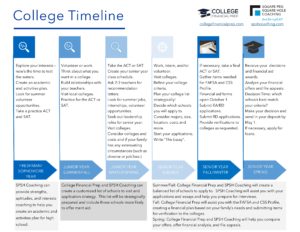
Key Dates at a Glance
| Date | What Happens |
| October 1 | FAFSA opens — file immediately |
| October 1 | CSS Profile opens |
| Oct 15 – Nov 15 | Early Decision / Early Action deadlines (varies by school) |
| December – January | Early Decision notifications; Regular Decision applications due |
| March – April | Regular Decision notifications released |
| April 1 | Most RD decisions arrive |
| May 1 | National Candidate Reply Date — enrollment deposit due |
The Questions Most Families Forget to Ask
Every year, families go through this process and arrive on May 1 having left money on the table or choices on the floor. Here are the questions worth asking at every stage:
- Are we thinking about financial fit as carefully as academic fit? The best school is the one your family can afford without an overwhelming debt load.
- Is our college list truly balanced? It’s best to have a list of reach, match and safety schools.
- Have we researched merit aid at match and safety schools? Sometimes the school that’s lower on the “prestige” ranking offers dramatically more scholarship money, making it the smarter long-term choice. And while everyone wants to know what is the #1 hardest college to get into or what is the #1 most applied to college (UCLA, for the record), the right question is: which school is the right fit for your student?
- Does my student know their “why” for each school? Specific, well-researched applications stand out.
- Have we looked at the net price, not just the published tuition? A school’s sticker price doesn’t tell you what your family will pay after grants, scholarships, and other aid.
- Are we paying attention to renewal requirements for scholarships? A generous first-year award isn’t as helpful if your student has to maintain an unrealistic GPA to keep it.
- Have we compared financial aid offers line by line? Two schools can offer the same dollar amount in aid while leaving your family with very different amounts to pay.
- Are we treating the FAFSA and other financial aid forms as part of the application process? Missing a financial aid deadline can cost families opportunities even when the student is admitted.
- Has my student considered what they actually want from the college experience? Location, class size, campus culture, academic support, housing, and access to internships can matter just as much as a school’s name.
- Are we choosing a school because it fits our student, or because it sounds impressive to everyone else? Prestige can be tempting, but it shouldn’t make the decision for you.
- What happens if our first-choice school doesn’t offer enough financial aid? Having a realistic backup plan before decisions arrive can make May 1 much less stressful.
- Are we looking beyond freshman year? Families should consider how tuition, housing, travel, fees, and other costs could change over four years.
- Does my student understand the commitment they’re making? Choosing a college is about choosing a place where they can realistically see themselves living, learning, and growing for the next several years.
The Bottom Line: A Plan Changes Everything
The college admissions process has a lot of moving parts. But the families who navigate it with clarity, who know what to do and when, who start conversations about money early, who give themselves enough time to do things well, consistently have better outcomes than those who try to figure it all out in the fall of senior year.
You don’t have to do this alone.
Want More?
Watch the full webinar that Vicki Vollweiler of College Financial Prep and I recorded together: The College Timeline, a deep dive into this roadmap with Q&A.
Need Personalized Guidance?
Every student’s path through this process is different. If you’d like expert support at any stage, from building your college list to polishing your essays to decoding your financial aid offers, I’m here to help.
Contact me and let’s map out your path from exploration to enrollment.
Eleanora Ferrante is a college admissions counselor helping students and families navigate the college search with clarity and confidence. Learn more